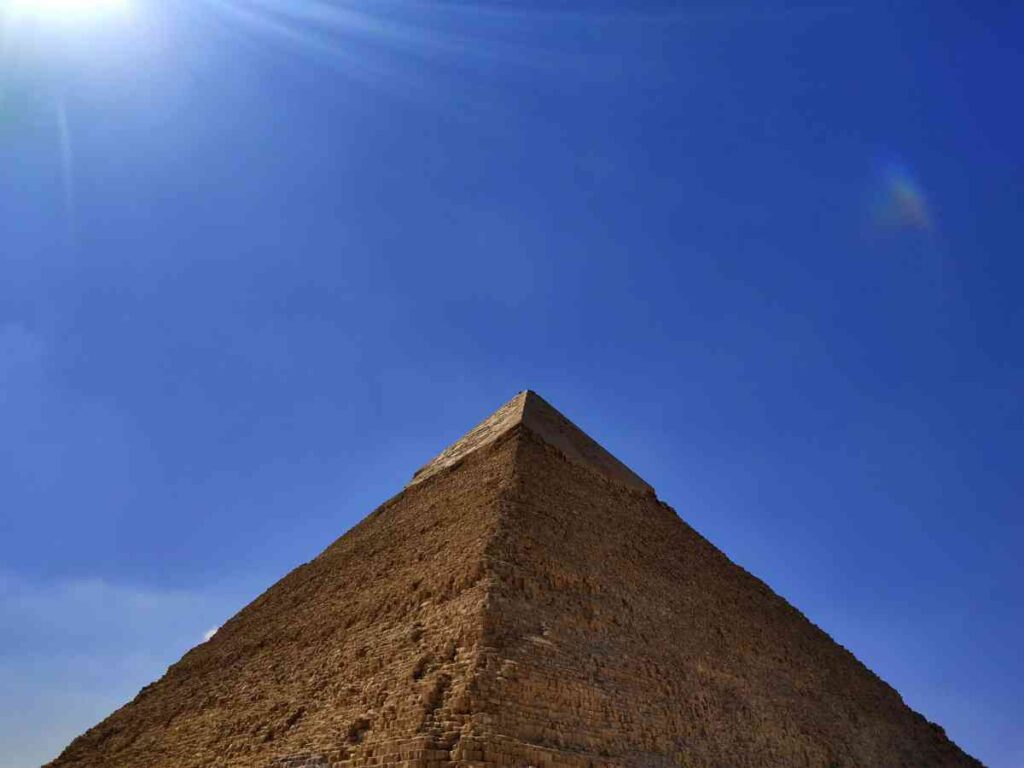
The Great Pyramids of Giza, standing as the last remaining wonder of the ancient world, continue to tower over the Egyptian desert as a symbol of eternal strength and architectural precision. Constructed during the Fourth Dynasty of the Old Kingdom for the Pharaohs Khufu, Khafre, and Menkaure, these colossal structures were designed not merely as grand tombs, but as gateways to the afterlife, aligning perfectly with the stars and the cardinal points of the compass. For over four millennia, the Great Pyramid of Khufu held the record as the tallest man-made structure on Earth, a feat achieved through the labor of tens of thousands of skilled workers who moved millions of tons of limestone and granite across the sun-drenched plateau. The sheer scale of the project, combined with the mathematical accuracy required to ensure the blocks fit together with hair-thin precision, remains one of the greatest mysteries in human history. To study the pyramids is to delve into a world where science, religion, and geography converged to create monuments that have defied time, weather, and the shifting sands of the Sahara. Even today, as modern technology scans the hidden chambers within, the pyramids remind us of the boundless ambition and ingenuity of a civilization that sought to touch the heavens and leave a permanent mark on the landscape of history.
The Mathematical Precision of the Great Pyramid
The construction of the Great Pyramid of Khufu is a masterclass in ancient geometry and astronomy. The four sides of the pyramid’s base are aligned almost exactly with true north, south, east, and west, with an error of less than a fraction of a degree. This level of accuracy suggests that the ancient Egyptians possessed an advanced understanding of the stars and the movement of the Earth. Furthermore, the ratio of the perimeter of the base to the height of the pyramid is remarkably close to the value of $2\pi$, a mathematical constant that many believe was intentionally integrated into the design. The blocks themselves, some weighing over 80 tons, were cut and leveled so perfectly that they fit together without any visible gaps. This precision was necessary not just for aesthetics, but for the structural stability of a monument intended to last for eternity. The use of the “golden ratio” in various aspects of the internal and external dimensions further highlights the sophisticated intellectual framework behind the physical labor.
The Logistics of Moving Mountains
One of the most debated topics among historians is how the Egyptians transported and lifted the massive stone blocks. Most of the limestone was quarried locally, but the white casing stones and the massive red granite slabs for the King’s Chamber were brought from Tura and Aswan, hundreds of miles away. It is now widely believed that the Egyptians used a combination of the Nile River for transport and a complex system of ramps, sledges, and lubricants—likely water poured on sand to reduce friction—to move the stones into place. Recent archaeological findings of worker villages and harbor installations at Giza suggest a highly organized logistical operation that involved specialized teams of masons, engineers, and support staff. This was not a project of slave labor, as once thought, but a national effort where workers were well-fed and provided with medical care, reflecting a society that was deeply invested in the divine legacy of their rulers.
The Spiritual Significance and the Afterlife
To the ancient Egyptians, the pyramid was a “Benben”—a symbol of the primordial mound from which the world was created. Its shape was intended to mimic the descending rays of the sun, providing a symbolic ramp for the Pharaoh’s soul to ascend to the heavens and join the sun god Ra. Inside, the pyramids contain a labyrinth of galleries, shafts, and chambers. The “Air Shafts” in the King’s Chamber are aligned with specific constellations like Orion and Sirius, which were associated with the gods Osiris and Isis. This celestial alignment ensured that the Pharaoh would find his place among the “imperishable stars” in the afterlife. The pyramids were also part of a larger funerary complex that included mortuary temples, causeways, and smaller “queen’s pyramids,” all designed to facilitate the complex rituals required for the transition from the physical world to the spiritual realm.
Geography and the Nile’s Life-Giving Force
The location of the Giza plateau was chosen with careful consideration of both geology and geography. It sits on a solid limestone bedrock that could support the immense weight of the structures without shifting. More importantly, its proximity to the Nile was essential for both the transportation of materials and the survival of the workforce. The annual flooding of the Nile provided the surplus food necessary to sustain such a massive non-agricultural project during the off-season. The relationship between the pyramids and the river also had a symbolic meaning; the Nile represented the flow of life, while the desert to the west, where the sun sets, was the land of the dead. By placing the pyramids on the western bank, the Egyptians ensured that their kings were positioned at the threshold of the eternal journey.
The Legacy of Modern Discovery and Preservation
Despite being studied for centuries, the Pyramids of Giza still hold many secrets. In recent years, projects using cosmic-ray muon radiography have detected large “voids” or previously unknown chambers inside the Great Pyramid, sparking new waves of excitement in the archaeological community. These discoveries remind us that even the most well-known landmarks on Earth have stories yet to be told. However, the pyramids also face modern challenges, including urban encroachment from the expanding city of Cairo and the effects of environmental pollution on the ancient limestone. Conservation efforts are now focused on balancing the needs of tourism with the necessity of preserving the site’s structural integrity. The pyramids are not just relics of the past; they are living laboratories for science and symbols of a heritage that belongs to all of humanity, teaching us that greatness is achieved through the marriage of vision and persistence.
Conclusion: A Monument to Human Potential
The Pyramids of Giza stand as a profound reminder of what humanity can achieve when it focuses its collective energy toward a singular, transcendent goal. They are a bridge between the finite world of stone and sand and the infinite world of the human imagination. In their silence, they speak of a civilization that mastered its environment, understood the laws of the universe, and sought to leave a legacy that would outlast empires. As we look upon these massive structures today, we are invited to reflect on our own place in history and the monuments—intellectual, cultural, or physical—that we are building for future generations. The pyramids remind us that while the sands may shift and the names of kings may fade, the spirit of innovation and the quest for immortality remain central to the human experience.