Dolphins are widely recognized as being among the most intelligent and socially complex animals inhabiting the world’s vast oceans today. Their remarkable ability to communicate effectively underwater plays a truly crucial role in their daily navigation, coordinated hunting cooperation, and the maintenance of deep social bonding within their communities. Scientists and marine biologists have spent many decades meticulously studying dolphin behavior to better understand how these extraordinary marine mammals exchange vital information beneath the waves. This sophisticated communication system is a blend of acoustic signals and physical gestures that allow them to thrive in diverse aquatic environments. Exploring their vocalizations and social structures provides us with a profound window into their cognitive depth and the importance of preserving their delicate marine habitats for future generations.
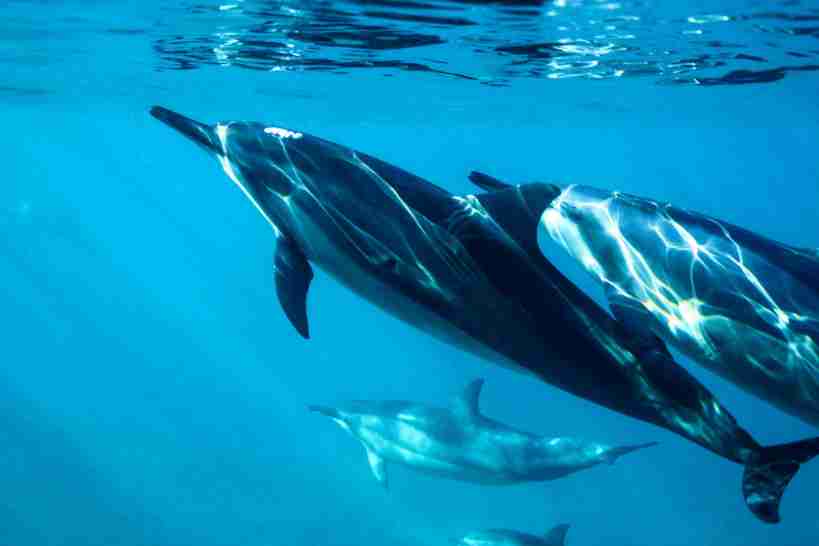
The Science of Sound: Acoustic Communication Methods Sound is the primary and most essential method dolphins use to communicate while submerged in the ocean’s depths. Because sound travels much faster and further in water than in air, dolphins have evolved to produce a variety of clicks, whistles, and pulsed sounds to convey complex information.
- Echolocation Clicks: These are high-frequency sounds that help dolphins navigate through murky waters, locate elusive prey, and understand their physical surroundings by interpreting the returning sound echoes. This biological sonar is so precise that a dolphin can determine the size, shape, and even the density of an object hundreds of feet away.
- Signature Whistles: Whistles are primarily used for social interaction and group identity. Interestingly, each individual dolphin develops a unique “signature whistle” during its early years, which functions almost exactly like a human personal identifier or name. These distinct sounds help dolphins recognize one another and maintain essential group cohesion, especially when traveling in large, fast-moving pods.
Physical Signals and the Language of Movement In addition to their advanced acoustic abilities, dolphins rely heavily on intricate body language and physical cues. Their communication is not just heard; it is seen and felt throughout the pod.
Coordinated swimming, high-speed leaping, and synchronized movements are common ways dolphins communicate a sense of unity and cooperation. When a pod moves in perfect harmony, it signals to outsiders and group members alike that they are a strong, singular unit. On a more individual level, tail slaps on the water’s surface or sudden, aggressive movements may signal urgent warnings of nearby predators or assert dominance during social disputes. Conversely, gentle touches, flipper rubbing, and close-proximity swimming are behaviors that indicate deep bonding, social affection, and emotional support. These physical cues add a necessary layer of depth to their underwater communication system that sound alone cannot provide.
Structured Communication: Purposeful Click Patterns Beyond the basic use of echolocation for navigation, research has revealed that dolphins also use highly specific and structured click patterns to convey complex messages. These are not random bursts of noise; they are structured sequences that can signal immediate danger, a request for assistance, or the initiation of specific social interactions.
Modern marine research suggests that dolphins possess the cognitive ability to recognize and respond differently to various click combinations, much like how humans distinguish between different words or phrases. This level of linguistic complexity highlights their advanced cognitive abilities and suggests a form of “proto-language” that is still being decoded by scientists today. This ability to structure sound into meaningful sequences allows for a level of cooperation in hunting and protection that few other species can match.
The Intersection of Social Structure and Communication Dolphin communication is fundamentally tied to their highly organized social structures. Dolphin pods are not just random groups; they consist of complex, long-term relationships, including clear leadership roles and lifelong social bonds.
Communication is the “glue” that helps maintain harmony within the pod. It allows them to coordinate their movements over thousands of miles, reinforce social hierarchies without the need for constant violence, and ensure the survival of younger members through shared knowledge. Their social organization is a testament to the fact that communication is essential for the survival of any intelligent, community-based species. By maintaining these strong social connections, dolphins can navigate their dangerous marine environment with remarkable efficiency and resilience.
Conclusion: The Sophistication of Marine Life In summary, dolphin communication underwater is a sophisticated and beautiful blend of sound, movement, and high-level social awareness. Through their unique vocalizations, nuanced body language, and structured click patterns, dolphins are able to maintain strong social connections and navigate the world’s oceans with extreme precision. Understanding these complex behaviors not only deepens our appreciation for dolphins as a species but also highlights the absolute importance of protecting their ocean habitats from human interference and pollution. As we continue to listen to the messages beneath the waves, we realize how much more there is to learn from these masters of the sea.