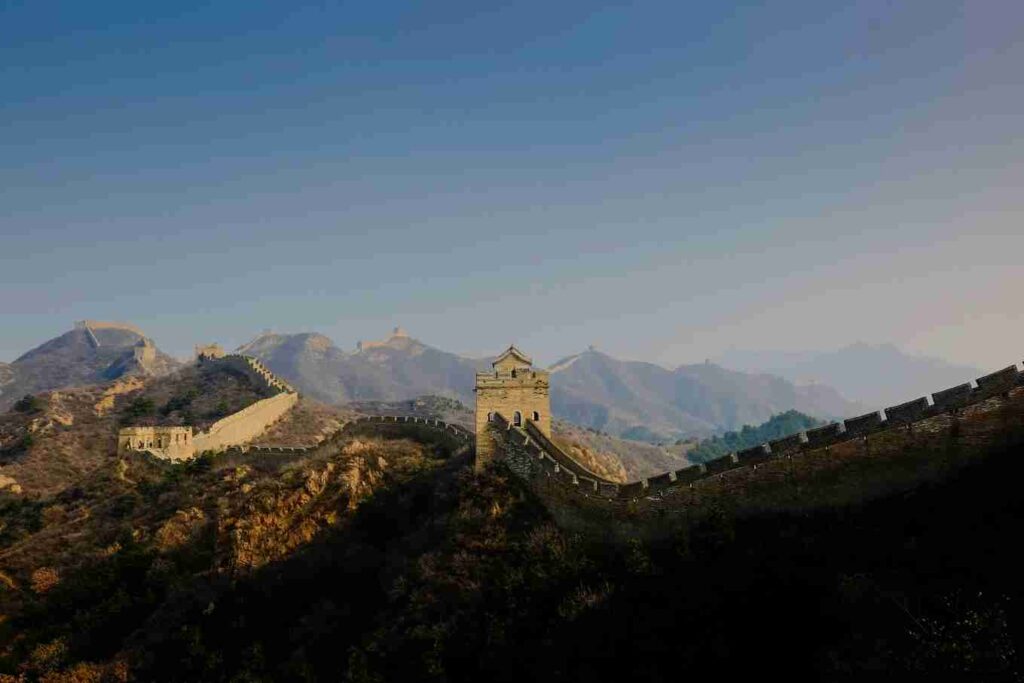
The Great Wall of China is perhaps the most iconic symbol of human perseverance and architectural ambition ever conceived, stretching thousands of miles across the rugged and varied landscapes of northern China. Built over two millennia by successive dynasties, this colossal fortification was designed not just as a physical barrier against nomadic invasions, but as a sophisticated system of communication, border control, and trade regulation. From the windswept deserts of the Gobi in the west to the precipitous mountain ridges of the east, the wall follows the natural contours of the geography, creating a seamless integration of man-made structure and natural terrain. It represents the collective effort of millions of soldiers, peasants, and prisoners who labored under extreme conditions to protect the heart of the Middle Kingdom. Today, the Great Wall stands as a monumental testament to the strategic vision and engineering ingenuity of ancient civilizations, offering a profound glimpse into the historical complexities of empire-building and territorial integrity. Exploring its vast reaches allows us to appreciate the sheer scale of human determination and the enduring legacy of a structure that has shaped the cultural and political identity of an entire nation for centuries.
The Evolution Across Dynasties The Great Wall is not a single, continuous structure but a series of walls and fortifications built during different periods. The earliest sections date back to the 7th century B.C., when independent states built walls to protect their borders. However, it was Qin Shi Huang, the first emperor of a unified China, who connected these fragments into a cohesive defensive system around 220 B.C. Later, during the Han Dynasty, the wall was extended even further west to protect the burgeoning Silk Road trade. The most well-preserved and famous sections we see today, however, were constructed during the Ming Dynasty (1368–1644). The Ming engineers significantly upgraded the wall, replacing earth and wood with durable bricks and stone. This evolution reflects centuries of changing military tactics and political priorities, showing how the wall adapted to meet the shifting threats of different eras.
Engineering Marvels in Treacherous Terrain Building a massive wall over steep mountain peaks and through shifting desert sands required unprecedented engineering solutions. In mountainous areas, workers used the “rammed earth” technique for the core, encasing it with bricks and stone slabs. To transport materials to high altitudes, they employed a combination of human chains, pack animals, and even primitive pulleys. The wall’s height and width were strategically varied depending on the terrain; in vulnerable areas, it was wider to allow several horsemen to ride abreast, while in naturally fortified ridges, it was narrower. The precision with which the stones were cut and fitted ensured the wall could withstand the harsh elements of northern China, including freezing winters and torrential rains. This structural integrity is the reason why significant portions of the Ming-era wall still stand today, centuries after their construction.
The Sophisticated Communication Network Beyond being a physical barrier, the Great Wall functioned as a high-speed communication network for the ancient world. At regular intervals, watchtowers were built to serve as command posts and housing for soldiers. More importantly, these towers were used to send signals across vast distances. Using smoke signals by day and fire by night, soldiers could transmit messages about enemy movements from the border to the capital in a matter of hours. This early “telegraph” system allowed the empire to mobilize its forces with incredible speed. Additionally, the wall served as a vital transportation corridor, allowing troops and supplies to move quickly across difficult terrain that would otherwise be impassable. This integration of defense and communication made the Great Wall one of the most effective military systems of its time.
Geography as a Natural Ally The designers of the Great Wall were master geographers. They meticulously chose routes that utilized natural obstacles like cliffs, rivers, and steep slopes to enhance the wall’s defensive capabilities. In many places, the wall is built along the “dragon’s back”—the very crest of the mountain ridges—making it nearly impossible for an invading army to scale. In the western reaches, where stone was scarce, the wall was made of layers of sand, gravel, and tamarisk branches, demonstrating an incredible ability to adapt to local environmental conditions. This symbiotic relationship between the structure and its environment is a key reason for the wall’s longevity and its status as a masterpiece of landscape architecture.
The Wall as a Gateway for Trade and Culture While its primary purpose was defense, the Great Wall also played a crucial role in economic and cultural exchange. Along the Silk Road sections, the wall acted as a regulated gateway where traders had to pay duties and follow specific protocols. This allowed the Chinese authorities to monitor who entered and exited the empire, facilitating safe trade while preventing smuggling. The garrison towns that grew along the wall became melting pots of different cultures, where soldiers from the interior of China interacted with nomadic tribes and foreign merchants. This exchange of ideas, languages, and technologies was as important to the empire’s growth as the physical protection the wall provided. It was here, at the fringes of the empire, that the diverse threads of Asian history were woven together.
Conclusion: A Symbol of Unity and Resilience The Great Wall of China is far more than a military relic; it is a profound expression of a civilization’s desire for security, order, and permanence. It stands as a reminder that the greatest human achievements often arise from the need to overcome immense natural and political challenges. As a UNESCO World Heritage site, it continues to inspire awe not just for its size, but for the story it tells of a people who refused to be defined by the limitations of their geography. In the modern era, the wall has transitioned from a barrier of exclusion to a bridge of cultural understanding, attracting millions of visitors who seek to connect with the deep history of the human spirit. The Great Wall remains an enduring landmark, proving that with enough vision and labor, humanity can create structures that transcend time and terrain.